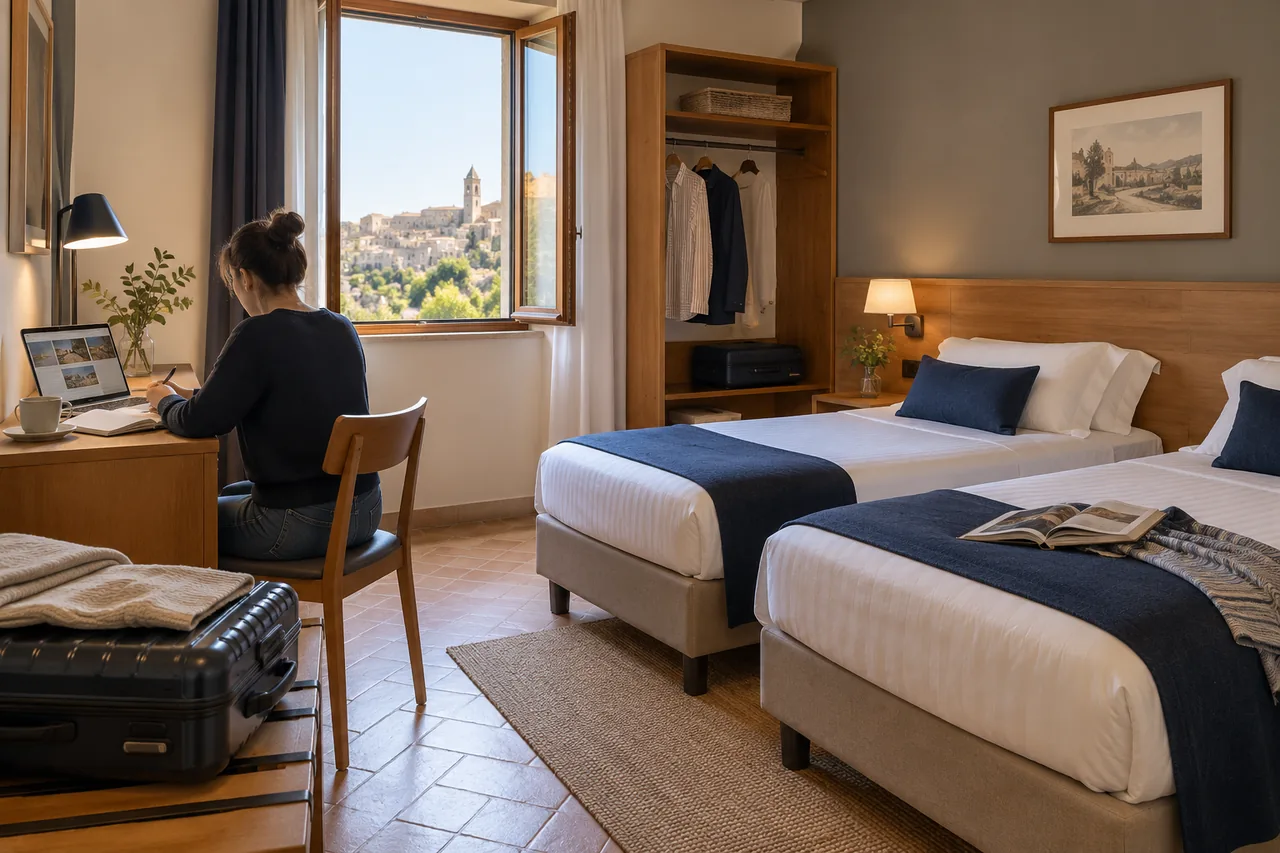
"Comfortable, welcoming rooms, tastefully furnished with every modern comfort." If your rooms page starts like this, the same sentence appears on thousands of other websites. It isn't wrong. It's just useless: it doesn't help guests choose a room or understand why to book it with you.
A good hotel room description has a practical purpose: to help guests picture their stay and remove every doubt before booking. Here's how to write one.
Words to avoid (or prove)
Comfortable, welcoming, elegant, refined, attention to detail, every comfort, oasis of relaxation. They aren't banned, but on their own they say nothing. If you use them, prove them with a concrete detail.
- ❌ "Comfortable room"
- ✅ "25 cm pocket-sprung mattress and a choice of memory foam or feather pillows"
The information guests are really looking for
Facts first. Every room page should answer these questions:
- How many people does it sleep, and with what bed configuration (double, twins, sofa bed, cot)?
- How big is it (in square metres)?
- What's the view? Balcony or terrace?
- The bathroom: shower or bath? Hairdryer, toiletries?
- Climate: air conditioning, individually controlled heating?
- Tech: Wi-Fi (fast?), TV, sockets near the bed?
- Quiet and light: street side or courtyard side? Blackout curtains?
- Accessibility: floor, lift, suitable for guests with reduced mobility?
The recommended structure
- A clear room name: "Family room with sea-view balcony" beats "Gardenia Room".
- One sentence saying who it's for: "Ideal for families with two children who want space and breakfast just steps away."
- Two or three lines of description with concrete, sensory details.
- A bulleted list of amenities and features.
- Real photos of the room, including the bathroom and view.
- An indicative price and booking button.
A before/after example
Before:
Superior double room, comfortable and welcoming, tastefully furnished with every comfort for an unforgettable stay.
After:
Superior Double with balcony – 22 m² For couples who like waking up to morning light. The balcony overlooks the inner garden, away from traffic: you'll actually sleep here. 180x200 king bed, a large walk-in shower and a desk by the window if you need to work for an hour. - Air conditioning and heating controlled in the room - Fibre Wi-Fi, 43" TV, safe, minibar - Blackout curtains - 2nd floor, with lift
The second version isn't longer to fill space. It's more useful.
Be honest about limits too
If a room is small, say so — and turn it into useful information: "Compact (14 m²) but well laid out: perfect if you travel light and spend your days out." Guests who know what to expect don't write negative reviews out of surprise. See how to present a hotel with dated rooms without creating false expectations.
Think about people searching on Google and AI
Clear, specific descriptions also help visibility: someone searching "hotel with family room for 5 in Rimini" needs to find those words on your pages. And when AI assistants recommend a hotel, they rely on precise, consistent information. See what information to publish to help AI assistants understand your hotel.
Use the same descriptions everywhere (but not copy-pasted)
Your website, Booking.com, Expedia and Google should describe the same room with the same basic information (size, beds, amenities). You can vary the wording, but the data must match. See how to keep hotel information consistent across website, OTAs and maps.
Frequently asked questions
How long should a room description be?
Usually 60–120 words of copy plus an amenities list is enough. What matters is that every sentence gives useful information.
Should I give rooms "fancy" names?
You can, but always pair them with a descriptive name: "Gardenia Room – Double with balcony". Guests need to understand immediately what they're booking.
Can I use AI to write the descriptions?
Yes, as a starting point, giving it all the real room data. Then reread and edit: AI tends to use exactly the generic phrases you want to avoid.
Want room pages that convince people to book?
With our free marketing audit we analyse the room pages on your website and OTAs and suggest how to make them clearer and more persuasive.


