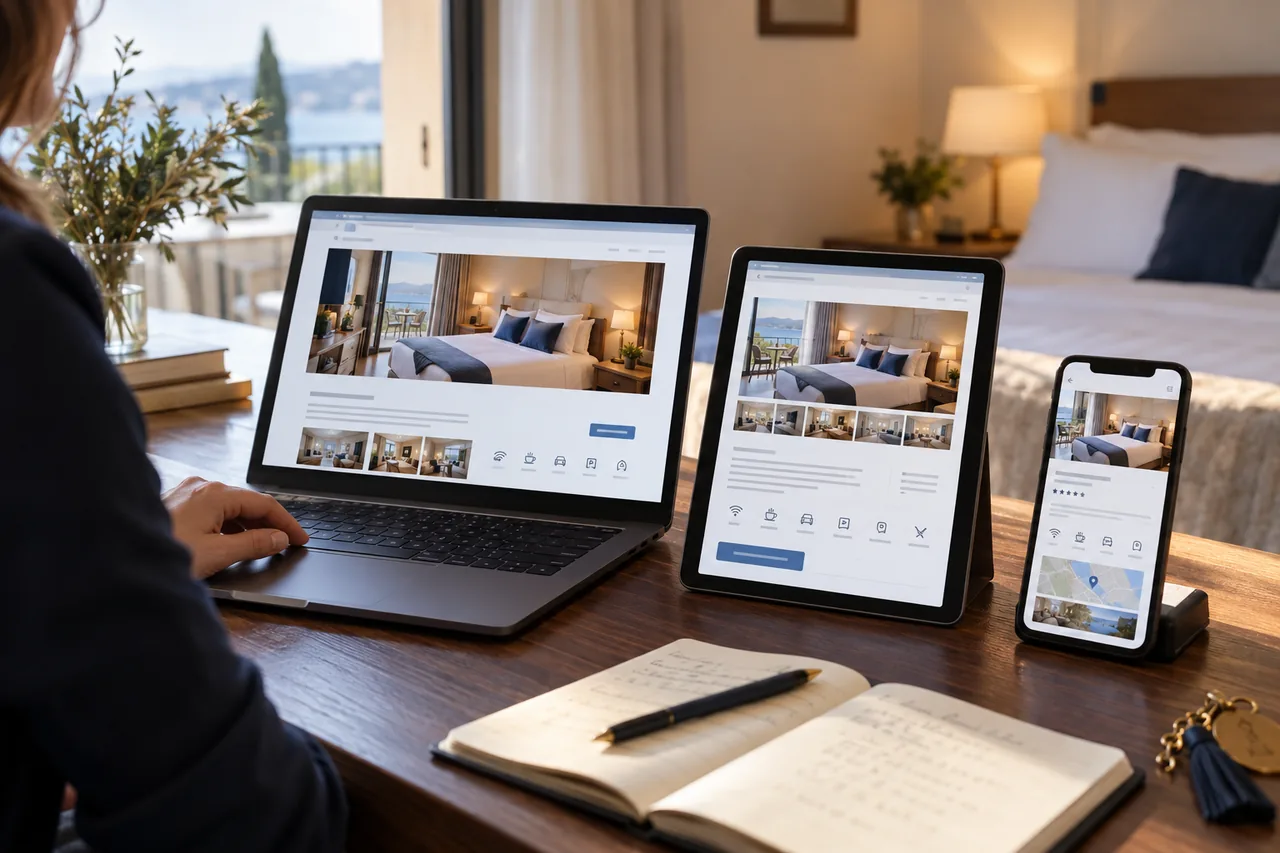
Your website says "check-in from 2pm". Booking.com says "from 3pm". Google says "from 1pm". Parking is free on your website, €12 on Expedia and "not available" on Tripadvisor. And the phone number on an old directory is the one from 2015.
They seem like details, but they aren't. Inconsistent information confuses guests, triggers negative reviews ("they told me that…") and makes it harder for Google and AI assistants to understand who you are. Let's put things in order.
Why consistency matters so much
- For guests: they find different information and don't know who to trust. When in doubt, they choose the platform they know (often an OTA).
- For Google: local ranking also relies on consistent name, address and phone across sources. Contradictory data weakens trust. See how to get found on Google by people looking for a hotel in your area.
- For AI assistants: they gather information from several sources; if sources conflict, they may pick the wrong one. See AI describes your hotel incorrectly: what can you do?.
- For reception: fewer questions, fewer complaints, fewer arguments at check-in.
Step 1: create your hotel's "official fact sheet"
An internal document, shared with whoever manages your channels, with all the official information:
| Category | Examples |
|---|---|
| Identity | Exact name, company name, category, registration code |
| Contacts | Full address with postcode, phone, email, WhatsApp, website |
| Times | Check-in, check-out, reception, breakfast, opening period |
| Rooms | Types, square metres, beds, maximum occupancy |
| Amenities | Parking (cost, spaces), pets, pool, spa, Wi-Fi, restaurant |
| Rules | Cancellation, payment, children, city tax |
| Location | Distances to points of interest, directions |
| Descriptions | Approved short and long copy |
| Photos | Official, up-to-date set |
This document is your "source of truth". Every change starts here.
Step 2: list all your channels
List everywhere your hotel appears:
- official website (all languages);
- Google profile;
- OTAs (Booking.com, Expedia, Airbnb and others);
- Tripadvisor and review sites;
- social media (Facebook, Instagram);
- local and regional tourism portals, tourist offices;
- directories, yellow pages, maps (Apple Maps, Bing);
- old websites or pages created by others.
Search Google for your hotel's name and address, and also your old phone number: you'll find pages you'd forgotten.
Step 3: align, starting with the most important channels
- Official website.
- Google profile.
- Main OTAs (channel manager for technical information, extranet for descriptions and amenities).
- Tripadvisor and social media.
- Local portals and directories.
Step 4: watch seasonal information
Many inconsistencies come from information that changes: pool open only in summer, shuttle only during trade fairs, restaurant closed in low season. Add a calendar reminder at every change of season to update all channels.
Step 5: assign responsibility
Who updates what? In a small hotel it's often the owner, but write it down anyway. When something changes, one person updates the official fact sheet and then every channel, using a checklist.
The most common mistakes
- the name written in different ways ("Hotel Sole", "Albergo Sole", "Sole Hotel Rimini");
- old phone numbers on directories;
- paid services listed as free (or vice versa);
- photos from different eras;
- different check-in times;
- translated pages inconsistent with the original language version.
Frequently asked questions
Does the hotel name need to be identical everywhere?
Yes, as far as possible. Small variations are common, but the main name, address and phone should be written the same way on every channel.
How do I find old listings I no longer manage?
Search Google for the hotel name, address and old phone numbers. For listings on portals you no longer use, contact the portal to update or remove them.
How often should I check consistency?
A full check once or twice a year, plus targeted updates whenever something changes.
Want to put your hotel's online presence in order?
With our free marketing audit we compare your hotel's information across your website, Google, OTAs and portals and give you a list of inconsistencies to fix.


