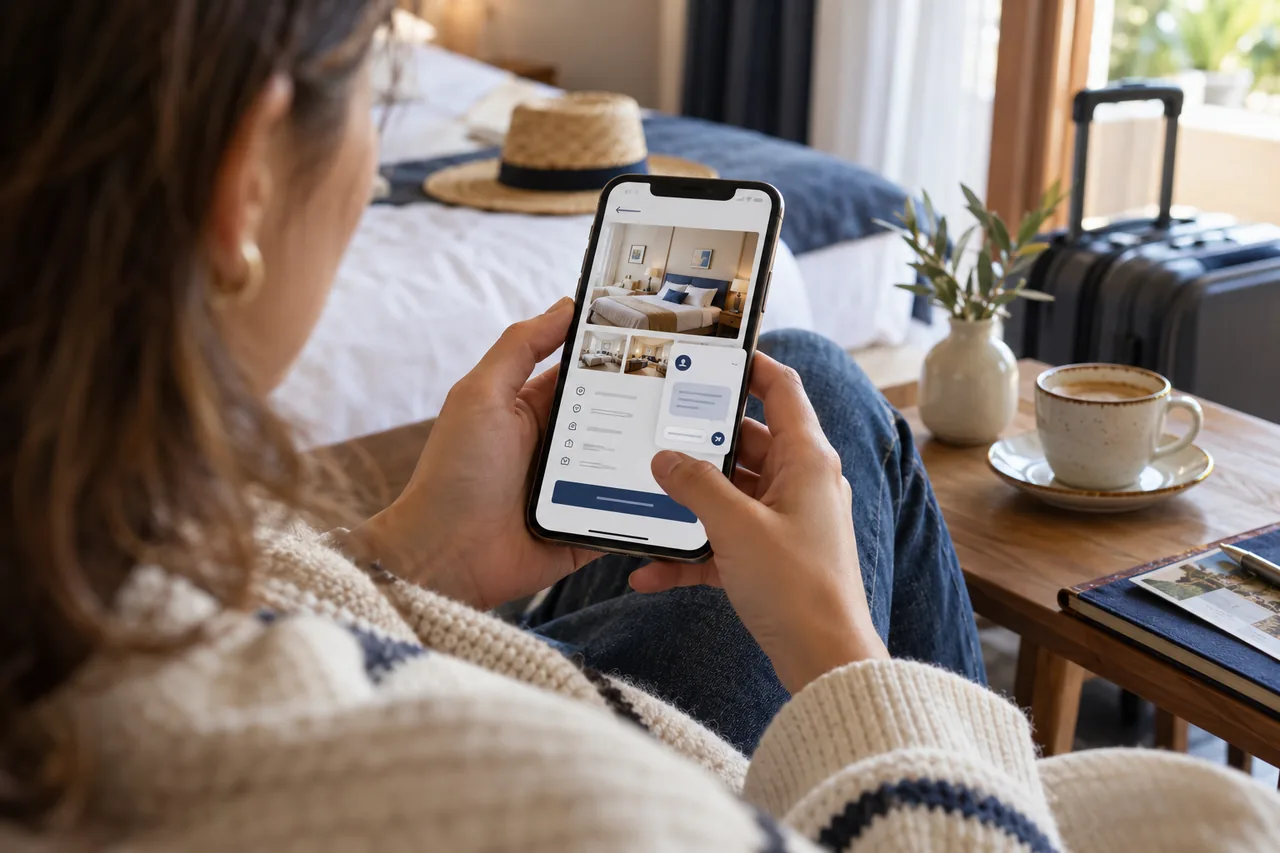
"Hi! I'm the hotel's virtual assistant. How can I help?" More and more hotel websites have a chat window in the bottom right corner. Some answer well, in several languages, at any hour. Others give vague or wrong answers, or send guests round in circles until they close the page.
An AI assistant on your hotel website can be a big help or an obstacle. Let's look at when it's worth it, when it isn't and how to design it to genuinely help guests (and bookings).
When an AI assistant really helps
- you get lots of repetitive questions (parking, pets, times, breakfast, distances);
- you have international guests writing in different languages;
- you receive requests out of hours, when reception is closed;
- your information is clear and stable, and you can give it to the assistant in full;
- you want to guide guests towards the right room and the booking engine.
When it risks confusing
- your hotel information is incomplete or contradictory (AI will repeat the errors or "fill in" with guesses);
- the assistant answers on prices and availability without being connected to real data;
- it covers the website with intrusive pop-ups, especially on mobile;
- it doesn't hand over to a person when the question is complex;
- your hotel is very small and requests are few: a good website with FAQs and WhatsApp may be enough.
What a good AI assistant should do
- Answer only with verified hotel information (FAQs, amenities, rules, location).
- Say "I don't know" and hand over to a person when it lacks an answer.
- Not invent prices or availability: for those, it should point to the booking engine or a connected system.
- Speak the guest's language.
- Guide towards action: links to the room, booking engine, WhatsApp or phone.
- Collect contacts for complex requests, with consent.
- Be discreet: an icon, not a window covering the "Book" button.
How to prepare it
- build a complete knowledge base: the same one you use for your website, OTAs and FAQs. See FAQs on your hotel website: which guest questions deserve an answer;
- define what it must not do (promise discounts, confirm availability, give medical or legal advice);
- set up handover to a person (email, WhatsApp, phone);
- test it with 50 real guest questions, in several languages, before going live;
- review conversations periodically to fix and improve.
See how to stop an AI assistant inventing hotel prices, services or conditions.
Website assistant or in-stay concierge?
Often more useful than a booking chatbot is an in-stay concierge: information on the destination, restaurants, transport, events, with service suggestions that go through reception. At our hotels in Rimini we use an AI concierge that suggests taxis, beach and theme parks: bookings go through reception, with more margin for the hotel and fewer repetitive questions for staff.
How to measure whether it works
- number of conversations and most frequent questions;
- share of answers resolved without human help;
- clicks from chat to the booking engine;
- bookings and enquiries generated;
- errors or complaints.
If the assistant causes confusion or errors, it's better to switch it off and fix the basics.
Frequently asked questions
Does a chatbot increase direct bookings?
It can help, especially by clearing doubts out of hours and guiding guests to the booking engine. But on its own it won't solve problems of price, visibility or a slow website.
How much does an AI assistant for hotels cost?
It depends on the solution: there are ready-made subscription tools and custom solutions. Weigh the cost against time saved and bookings generated.
Do guests trust chatbot answers?
If answers are precise and there's always the option to talk to a person, yes. Trust is lost at the first wrong answer.
Want to know if an AI assistant would help your hotel?
With our free marketing audit we analyse the requests you receive and your website and tell you whether an AI assistant (or concierge) can really help. If it makes sense, we build it to measure.