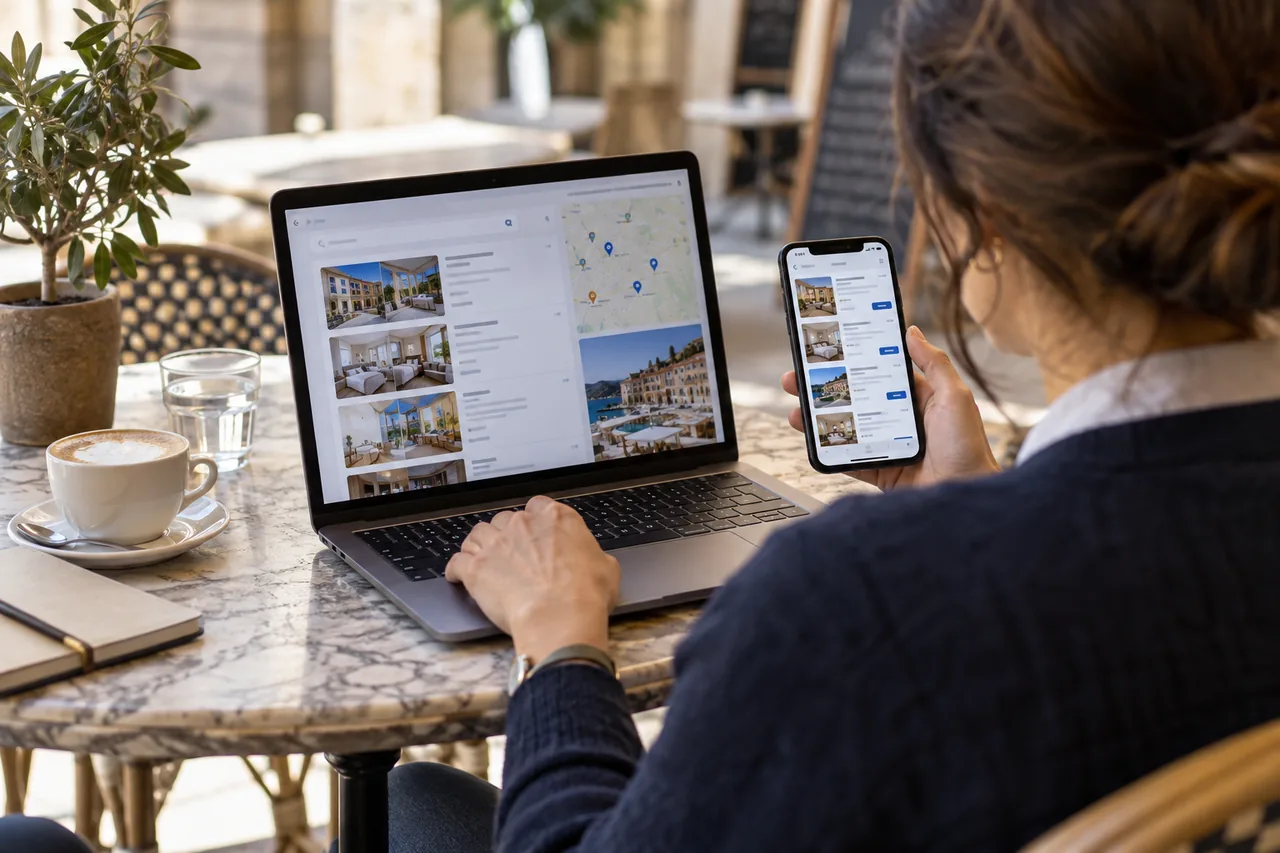
Here's a scene that repeats every day: a guest discovers your hotel, types its name into Google, looks at the photos, reads a couple of reviews… and then books on Booking.com. They had already chosen you. Yet you pay commission as if the portal had found them.
It's one of the most painful losses for a hotelier, because it involves guests who were already "yours". In this article we look at why it happens and how to bring those bookings back to your website.
What guests see when they search your name
Try it now: take your phone, open Google in incognito mode and search your hotel's name plus the town. You'll probably see:
- at the top, one or more ads (often from OTAs);
- your hotel panel on the right (or at the top on mobile), with photos, reviews and a price module listing Booking.com, Expedia and others;
- organic results: your website, but also OTA pages, Tripadvisor and other sites.
On this page you have a few seconds to convince the guest that your website is the best place to book. And often the page works against you.
The 6 most common reasons
1. Your website isn't in the price comparison
In the hotel panel, Google shows prices from those connected to its system. If your booking engine isn't, only the OTAs appear. Guests click what they see. Fix: switch on free booking links on Google.
2. Your website price is higher
If the price comparison shows your website at €130 and Booking.com at €117 (maybe due to a Genius discount or a forgotten promotion), the choice is obvious. See why Google shows OTA rates but not your hotel's.
3. OTAs advertise on your name
Some OTAs and metasearch sites buy ads on hotel-name searches. People searching your name see, as the first result, an ad leading to a portal. Consider a brand campaign: should you advertise on your own hotel name?.
4. Your website doesn't build trust or is awkward on mobile
The guest lands on your website, but it's slow, the photos are old, the booking button is hard to find. They go back and book on Booking.com, where they know everything works. More in how to tell if your hotel website builds trust.
5. They feel safer on Booking.com (or think they do)
Free cancellation, pay at the property, loyalty points, verified reviews: the guest feels more protected. If your website offers the same or worse conditions, there's no reason to take the risk.
6. No reason to book direct
If your website doesn't clearly say "book here and get X", guests won't guess it. You need a visible perk. Ideas in how to make booking direct worthwhile without always lowering the price.
The upside: the billboard effect
Cornell University research on the billboard effect showed that OTA presence also drives searches and direct bookings: many guests discover a hotel on a portal and then look it up elsewhere. A 2017 update found that almost two-thirds of direct bookers had visited an OTA during their research.
In other words: Booking.com brings the guest to the door. It's up to you to have them walk in through yours.
Checklist to win back these bookings
- Connect your booking engine to Google (free links and, if it makes sense, Google Hotel Ads).
- Check every week that your website price isn't higher than the OTAs.
- Show an exclusive direct-booking perk near the top of your homepage.
- Make your website fast and the "Book" button always visible on mobile.
- Offer cancellation terms at least as good as the OTAs.
- Monitor searches for your name: if you see OTA ads, consider a brand campaign.
- Look after your Google profile: photos, amenities, correct links to website and booking engine.
Frequently asked questions
How can I tell how many people search my hotel's name?
Google Search Console shows the queries that bring people to your website, including those with the hotel name. Your Google Business Profile stats show how often the profile was viewed and how people found you.
Can I stop OTAs advertising on my name?
You can protect your registered trademark through Google Ads' procedures and check whether your OTA contract covers the use of your brand. In practice, the most effective solution is often to show up first yourself.
Do free booking links cost anything?
Clicks on free booking links cost nothing. Some booking engine providers may charge for the connection: ask about their terms.
Want to win back bookings from guests who already chose you?
With our free marketing audit we analyse what guests see when they search your hotel on Google and tell you how to bring those bookings to your website.
Sources: Cornell University – The Billboard Effect (2009, 2017 update), Google – Free booking links guide.